Smart Cities - BirdNET-Pi Project
BirdNET-Pi Course Overview
| One | Two | Three |
|---|---|---|
| Lesson 1 | Installation of BirdNET-Pi on a Raspberry Pi | 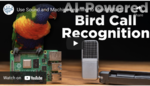
|
| Lesson 2 | Maintenance of BirdNET-Pi and Registration on BirdWeather | 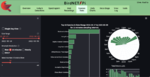
|
| Lession 3 | Using APIs to extract data from BirdWeather | 1.00 |
| Lesson 4 | Saving API data as a text file and creating a Dashboard in Node-RED | 1.00 |
| Lesson 5 | Saving API data in a SQLite database and creating a Dashboard in Node-RED | 1.00 |
Overview
- BirdNET-Pi uses a USB microphone connected to a Raspberry Pi to record and identify bird calls.
- The system runs 24/7 and can upload data in real time to https://app.birdweather.com
- Data can also be downloaded via an API so that you can do some additional data processing using Node-RED.

Hardware requirements
- Raspberry Pi 4 or Pi 3 B+.
- USB Microphone - (e.g. Gyvazla USB Microphone Lavalier Clip-on Omnidirectional Condenser Microphone for Computer)
- Heat sink and fan for Raspberry Pi. Optional, but highly recommended because it will keep the processor temperature less than 40degC and prolong the life of your Raspberry Pi.
Full Installation instructions
- Installation instructions are also available from the creator of BirdNET Pi (Patrick McGuire) - Lite version (no GUI interface)
https://github.com/mcguirepr89/BirdNET-Pi/wiki/Installation-Guide
Bird NET Pi - Adam's system
- Most Bird NET Pi systems are available through Bird Weather
- Adam has also made his Bird NET Pi installation directly available on the internet Online example of Raspberry Pi Bird NET Pi
Microphone installation for testing
- Plug the microphone into the USB 3.0 port.
- The USB 3.0 plug is coloured, either blue or yellow.
Microphone final installation
- The microphone needs to be installed on the exterior of the house to receive bird calls.
- Open a window and place the microphone in a sheltered location under and eave so that the microphone doesn't get wet.
- Use sticky tape to attach the microphone to the house.
- Close the window carefully so that the cable connected to the microphone is not damaged.
Installing the BirdNET-Pi app
- Open the Terminal
- Enter the following code curl -s https://raw.githubusercontent.com/mcguirepr89/BirdNET-Pi/main/newinstaller.sh | bash
- The code was obtained from this site https://birdnetpi.com
- If prompted, answer Y (yes) to any questions.
- The installation will take approximately 15 minutes.
- The Raspberry Pi will reboot once the installation is complete.

Demonstrating BirdNET-Pi
- In this example, the installation will be reachable at "http://birdnetpi1.local",
- Open up a Web Browser on any computer on the same local network as the Raspberry Pi running BirdNET-Pi

- This will open up the BirdNET-Pi Home Page.

Swap file expansion
[Expanding the swap file on the Raspberry Pi]
Testing a Bird Call
Maintenance Requirements for BirdNET-Pi
- General maintenance requirements are explored in this Dropbox video https://www.dropbox.com/s/vpv6z15gsozkqvn/video1668020945.mp4?dl=0
- Restart BirdNET-Pi Raspberry Pi once per week.
- Monitor temperature of Raspberry Pi to check to see if it has been throttled due to exceeding 60degC.
- Check to see if the Micro SSD card is full.
- Complete any updates.